


There is a moment almost every new blogger experiences.You publish your first article. You feel good about it because you have spent hours researching, writing, editing and making sure everything looks right. You press publish and then, naturally, you start wondering when the visitors are going to arrive.
So you check your analytics. Nothing. You check again later. Still nothing. The next day, you check again. Maybe you have a few visitors, but nowhere near the numbers you imagined. If that sounds familiar, I want you to know something before you start changing everything on your website.
Your blog may not be failing. You may simply be early.
I have had to remind myself of this more than once during my own affiliate marketing journey. One of the hardest things about building an online business is that the work you do today does not always produce an immediate result. Sometimes you are building something that nobody can see yet. And that can make it very difficult to stay motivated.
In my experience, low traffic usually isn’t caused by one single problem. There can be several reasons why a blog isn’t getting visitors, and understanding those reasons is much more useful than simply assuming your content isn’t good enough. So let’s look at what could actually be happening.
My Experience With Low Traffic
When I restarted my affiliate marketing journey, I had to accept something I wish I had understood much earlier. Creating content and getting traffic are two different jobs. Writing an article is content creation. Getting that article in front of people is content distribution.
I used to think that if I created a useful article, optimised it properly and published it, the rest would eventually take care of itself. Unfortunately, it doesn’t quite work that way. There are millions of pieces of content competing for attention online. Even a genuinely useful article can sit quietly if nobody has discovered it yet.
That realisation changed the way I approach my website. Instead of asking only, “Is this a good article?” I started asking another question: “How are people going to find this article?” That question is incredibly important for anyone building an affiliate marketing website.
 If you’re new to affiliate marketing, or you’re still waiting for things to click finally, I’d love to help. I’ve created a Beginner Guide that covers everything I wish someone had shown me when I was starting out. If you think it could help you too, you can read it here.
Your Blog Needs Time to Develop
One of the biggest mistakes beginners make is expecting a new website to behave like an established website. An established website may already have years of content, backlinks, returning visitors, email subscribers and search engine visibility.
A new website doesn’t have those advantages. You are starting from scratch. That means your first articles may not receive much traffic. Your first Pinterest pins may not receive many impressions.
Your email list may be tiny. And your search rankings may be nowhere near where you want them to be. None of that automatically means you are doing something wrong. You are building the foundation.
Think about it like planting a garden. You don’t plant a seed in the morning and become frustrated because there isn’t a tree by lunchtime.
- You water it.
- You give it sunlight.
- You look after it.
- Then you give it time.
Building a blog is similar. The work you are doing today can become much more valuable later.

Reason #1: You Haven’t Created Enough Content Yet
This is probably one of the simplest explanations. Your blog may not be getting traffic because there simply isn’t enough content for people to discover yet. If your website contains five articles, there are only five major opportunities for someone to enter your website through your blog.
If you eventually have fifty useful articles, you have created fifty opportunities. That does not mean you should publish fifty articles just for the sake of having fifty articles. Quality still matters. But beginners sometimes expect one or two articles to transform their website.
Usually, it takes a body of useful content to start creating momentum. This is why I prefer thinking about my articles as assets rather than isolated blog posts. Each useful article becomes another piece of the business.
Reason #2: Nobody Knows Your Content Exists
This is one of the biggest lessons I have learned. You can write the best article in your niche and still receive very little traffic if nobody knows it exists. That is why content distribution matters. You need ways of getting your content discovered.
For me, Pinterest has become an important part of that process. Instead of publishing an article and simply waiting for search engines to find it, I can create Pinterest pins that introduce people to the article. One article can become several different pins. Each pin can approach the topic from a different angle.
That means I am giving the article more opportunities to be discovered. This is also where the strategy from my previous article comes into play. If you haven’t read Pinterest vs Google SEO for Beginners, I recommend reading that next because it explains why I don’t see Pinterest and Google as competitors. They can serve different purposes within the same content strategy.
Reason #3: You’re Targeting Topics Nobody Is Searching For
Another possibility is that your content is useful, but the topic itself doesn’t have enough demand. This can happen easily when you are passionate about your niche.
- You think of a topic.
- You know a lot about it.
- You write an excellent article.
But there may not be many people looking for that particular information. That doesn’t necessarily make the article useless. It simply means you need to understand your audience better. Before writing an article, ask yourself:
- What problem is my reader trying to solve?
- What question are they asking?
- What would make them stop scrolling?
- What information would actually help them?
The better you understand those questions, the easier it becomes to create content people want to discover.

Reason #4: You’re Competing Against Very Strong Websites
This is another area where beginners can become discouraged. Imagine you write an article targeting a broad topic such as “affiliate marketing”. You search Google and discover that the first page is dominated by huge websites with thousands of articles, years of history and significant authority.
It can be difficult to compete directly with them. That doesn’t mean you should abandon SEO. It means you need to become smarter about the topics you target. Instead of trying to rank for everything, you can look for more specific questions and beginner focused topics.
For example, instead of targeting: Affiliate Marketing you might create content around: How to Start Affiliate Marketing With No Experience or: How to Choose an Affiliate Marketing Niche as a Beginner Those topics are more specific. specificity can give a newer website a better opportunity to build relevance.
Reason #5: Your Headlines Aren’t Giving People a Reason to Click
Sometimes the content is fine. The problem is the packaging. Think about your article title. If someone sees it in a search result or on Pinterest, does it immediately tell them what they will get?
Compare these two titles: Affiliate Marketing Tips and: Affiliate Marketing Mistakes Beginners Should Avoid The second one gives the reader more information. It creates curiosity. It tells them who the article is for. And it promises a specific benefit. Your headline doesn’t need to be sensational. It simply needs to communicate value clearly.
Reason #6: You’re Not Using Internal Links
Internal linking is one of those simple things that can make a big difference to the structure of your website. Let’s say someone lands on your article about Pinterest traffic. Inside that article, you could link to another article about building an affiliate marketing habit.
You could also link to your beginner guide. Then perhaps another article explains how to stay organised. Suddenly, one visitor has several useful paths through your website.
This is important because your goal isn’t simply to get someone to read one article and leave. You want to help them continue learning. Over time, that can help turn a collection of individual articles into an actual content ecosystem.
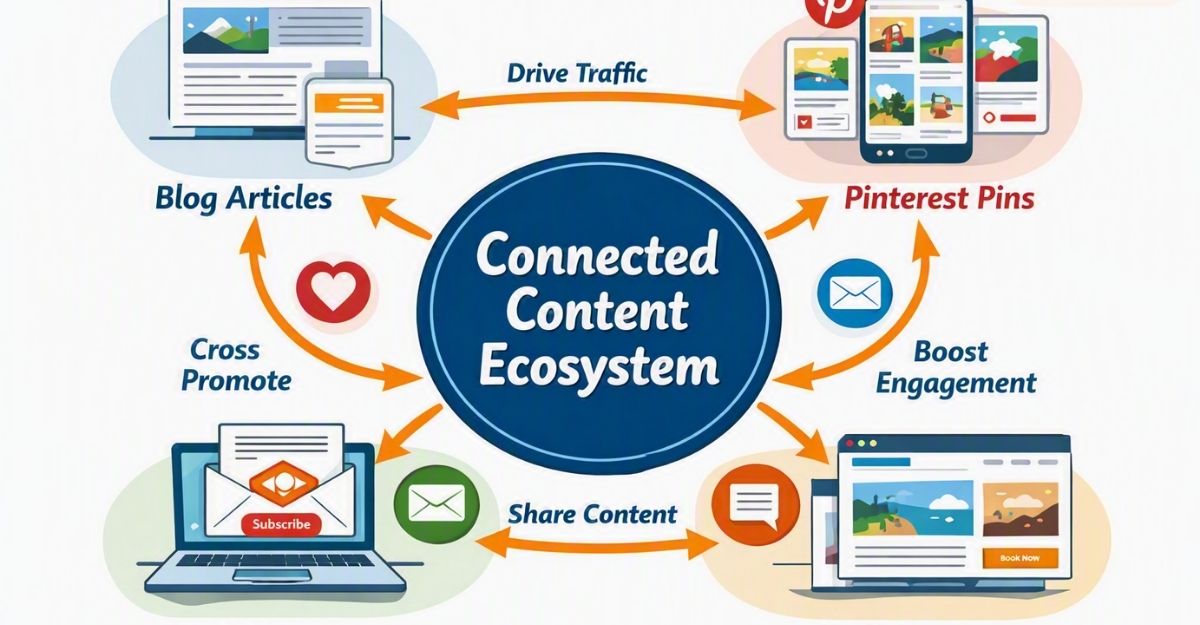
Reason #7: You’re Trying Too Many Traffic Sources at Once
This one is easy to fall into. You hear that Pinterest works. Then you hear about Google SEO. Then someone tells you to start YouTube. Someone else says TikTok is the answer. Another person recommends Facebook.
Before long, you are trying to create content for five different platforms while also trying to maintain your website. I have learned that this can quickly become overwhelming. You don’t need to be everywhere. You need a system you can actually maintain.
For my current strategy, Pinterest is the primary traffic distribution channel. That doesn’t mean I ignore SEO.It means I have chosen where I want to put most of my energy. That makes the work much more manageable.
The Traffic Foundation Framework
This is where I would introduce another one of my Frameworks. I call it The Traffic Foundation Framework. It has four simple parts:
Content → Discovery → Trust → Action
Your content needs to provide value. Your discovery system needs to help people find it. Your website needs to build trust once they arrive. And eventually, your visitor needs a clear next step.
That could be joining your email list, reading another article, visiting your beginner guide or learning about a product or programme you genuinely recommend.
Traffic without trust isn’t enough. And traffic without a clear next step can easily disappear. That is why I don’t look at traffic numbers in isolation look at the entire journey.
Why Pinterest Can Help
Pinterest is particularly useful here because it gives you another way to introduce people to your content. A visitor might never discover your article through Google today. But they could discover one of your pins.
- They click.
- They arrive at your article.
- They find the information useful.
- Then they discover another article.
Eventually, they might join your email list. That is a completely different journey from simply hoping somebody types a keyword into Google and finds your website.
Pinterest doesn’t guarantee traffic. But it gives your content another doorway. And when you are building a new website, having multiple reasonable ways for people to discover your content can be valuable.

Don’t Judge Your Blog Too Early
This is probably the biggest piece of advice I would give a new blogger. Don’t judge the entire business based on the first few weeks. It is very easy to become obsessed with numbers.
- Impressions.
- Clicks.
- Visitors.
- Followers.
- Email subscribers.
- Commissions.
Of course, these numbers matter. But early on, you should also be tracking something else.
Are you building?
- Did you publish another useful article?
- Did you create your pins?
- Did you improve your website?
- Did you add internal links?
- Did you learn something from your analytics?
- Did you keep going?
Those are also results. They may not appear in your traffic dashboard, but they are moving the business forward.
What If You Have Been Blogging for Months?
Now, if you have been publishing consistently for several months and your traffic is still extremely low, then it is worth investigating.
- Look at your content.
- Look at your topics.
- Look at your search visibility.
- Look at your Pinterest performance.
- Look at your titles.
- Look at your internal linking.
- Look at where your visitors are coming from.
You may discover that the problem isn’t your effort. It may be your strategy. That is an important distinction. f the strategy isn’t working, don’t simply work harder at the same strategy. Look at what the numbers are telling you and adjust.
What I Would Do If My Blog Had Almost No Traffic
If I were starting with a website that had very little traffic, I wouldn’t panic. I would start by looking at the content I already have. I would identify the articles that have the strongest potential. Then I would improve them rather than immediately creating another twenty articles.
I would strengthen the titles. Improve the introduction. Add useful internal links. Make sure the article actually answers the reader’s question. Then I would create Pinterest pins around those articles.
After that, I would continue publishing new content around closely related topics. This creates something much more valuable than random traffic. It creates a connected library of information.
Give People a Reason to Stay
Getting someone to your website is only the beginning. Once they arrive, what happens next? Do they see another useful article? Can they find your beginner guide? Is there an opportunity to join your email list? Do they understand who you are and why they should trust your recommendations?
This is where I believe personal experience becomes extremely important. People don’t just want information anymore. They want to know whether the person giving them that information understands what it feels like to be where they are.
That’s why I include my own experiences throughout my content. I don’t want to pretend that I have everything figured out. I want beginners to know that I am building too.

One of the biggest myths surrounding affiliate marketing is that there is some secret traffic method that suddenly changes everything. There isn’t.
- There are strategies.
- There are systems.
- There are platforms.
- There are techniques.
But none of them remove the need to create useful content, understand your audience and keep improving. The traffic usually comes from putting those pieces together consistently. that may not sound exciting. But it is realistic. And realistic expectations are much healthier when you are building an online business.
Final Thoughts
If your blog isn’t getting traffic yet, don’t automatically assume that you have failed. Take a step back and look at the bigger picture. Maybe your website is still young. Maybe you need more content. Maybe people haven’t discovered your articles yet.
Maybe you are targeting topics that are too broad. Maybe your headlines need work. Maybe your internal linking needs attention. Maybe you are trying too many traffic platforms at once.
Or perhaps your strategy simply needs some adjustment. The important thing is to diagnose the problem before deciding that the entire business isn’t working. I have learned that building an affiliate marketing website is much more like building a garden than flipping a switch.
- You plant.
- You water.
- You learn.
- You adjust.
And you keep going.Some things grow faster than others.But every useful piece of content you create can become another asset working for you.So if your traffic is low today, don’t throw everything away.
Ask yourself what your website needs next. Then do that.
- One article.
- One pin.
- One improvement.
- One day at a time.
That is how momentum is built.
Ready to Build Your Affiliate Marketing Foundation?
If you’re still working out how all of this fits together, my Beginner Guide to Affiliate Marketing is a good place to continue. It walks through the basic process and helps put the individual pieces into perspective.

And if you’re looking for a platform where you can learn while building your own online business, you can also read my Wealthy Affiliate Review, where I explain my experience and what the platform offers beginners.

You don’t need thousands of visitors to start building. You need to start building the right foundation.
Pinterest vs Google SEO for Beginners
Understand how Pinterest and Google differ and why I believe both can play a role in a beginner’s traffic strategy.
How to Get Traffic from Pinterest for Affiliate Marketing: A Beginner Guide
A practical introduction to using Pinterest as part of your affiliate marketing traffic strategy.
How to Build an Affiliate Marketing Habit
Building traffic takes consistency. This article explains how creating a simple working habit can help you keep moving forward.
How to Stay Organised as an Affiliate Marketer
As your content library grows, organisation becomes increasingly important. A simple system can help you manage articles, pins and other parts of your business.
Frequently Asked Questions
Why is my new blog getting no traffic?
A new blog often needs time to build content, authority and visibility. It may also need a stronger content distribution strategy. Low early traffic does not automatically mean the content is poor.
How long does it take for a blog to get traffic?
There is no guaranteed timeframe. It depends on factors such as your niche, content quality, competition, SEO, distribution and consistency. Some content can gain attention quickly, while other articles take much longer.
How many blog posts should I have before expecting traffic?
There is no magic number. Rather than focusing on a specific number, concentrate on building a useful collection of articles around closely related problems and questions your audience has.
Can Pinterest help a new blog get traffic?
Pinterest can provide another way for people to discover your content. It does not guarantee traffic, but creating useful pins around your articles can give your website additional opportunities to be discovered.
Should I focus on SEO or Pinterest?
You can use both. SEO can help build long term organic search visibility, while Pinterest can act as a content distribution channel. The key is choosing a manageable system rather than trying to master every platform simultaneously.
Why are my blog posts not ranking on Google?
New websites often face strong competition from established websites. Your content may also be targeting broad or highly competitive topics. More specific beginner focused topics can sometimes provide better opportunities.
Should I stop blogging if I have no traffic?
Not necessarily. First investigate why traffic is low. Look at your topics, content quality, SEO, headlines, internal links and distribution. You may need to adjust the strategy rather than abandon the business.