


When I first started creating content for my affiliate marketing website, I was mostly thinking about the next article. What should I write about? What keyword should I target? What would my readers find useful? Those are all reasonable questions, but over time I started thinking about something else.
What happens to this article after I publish it?
Does it have a short shelf life, or could it continue helping people months or even years from now? That question introduced me to one of the most useful concepts in content marketing: evergreen content. The idea is actually quite simple.
Evergreen content is content that stays useful and relevant over a long period of time. It isn’t dependent on today’s news; it isn’t built around something that will disappear next week. Instead, it answers a question, solves a problem or teaches something that people are likely to continue searching for.
And for someone building an affiliate marketing business, I think this is particularly important, because when you are working with limited time, you want some of the work you do today to continue creating value tomorrow.
What Does Evergreen Content Actually Mean?
The easiest way I can explain evergreen content is by comparing it to something with a short shelf life. Imagine you write an article called:
The Best Affiliate Marketing Trends for August 2026
That article might receive attention because it is up to date. But eventually August 2026 will pass. The information becomes less relevant. You may need to update it or replace it. Now compare that with:
How to Choose an Affiliate Marketing Niche
The second topic isn’t tied to a particular month or year. Someone starting affiliate marketing next year could still find it useful. Someone searching for the same information several years from now could potentially benefit from it too. That’s the basic idea behind evergreen content: it continues to have value after the original publication date.
My Experience With Evergreen Content
As I have built my own content library, I have become much more aware of how valuable evergreen articles can be. Creating content takes time. Even when I have a clear system, there is still research, writing, editing, images, internal links, Pinterest pins and everything else that goes into getting an article ready.
So I don’t want every article to have a short life. I want some of the content I create to keep working. That doesn’t necessarily mean an article will generate traffic every single day. It doesn’t mean every evergreen article will become popular.
And it certainly doesn’t mean you can publish something once and forget about it forever. But it does mean that the foundation of the article can remain useful. That is a very different way of looking at content creation.
Instead of asking: What can I publish today? I can also ask: What can I create today that might still be useful later? That small change in thinking can make a big difference.
 If you’re new to affiliate marketing, or you’re still waiting for things to click finally, I’d love to help. I’ve created a Beginner Guide that covers everything I wish someone had shown me when I was starting. If you think it could help you too, you can read it here.

Why Evergreen Content Matters for Affiliate Marketing
Affiliate marketing is not simply about getting somebody to click an affiliate link. You are building a website. You are building an audience. You are building trust. And ideally, you are building an asset that becomes more useful over time.
Evergreen content can support that process. Imagine you create an article explaining how affiliate marketing works for beginners. A person discovers it through Pinterest. They read the article, then they find another article explaining how to choose a niche, then they read your beginner guide.
After perhaps they join your email list. That one evergreen article has become an entry point into your wider content ecosystem, and that is where I think evergreen content becomes much more powerful. The article isn’t simply an article anymore. It becomes part of the journey.
Evergreen Does Not Mean “Never Update It”
This is an important distinction. Some people hear the word evergreen and assume that once an article is published, it never needs to be touched again. That’s not quite right. An evergreen topic can remain relevant while the information inside the article changes.
For example, an article about Pinterest for affiliate marketing can remain useful for years. But Pinterest itself changes. Features change. Best practices change. User behaviour changes. Your own experience changes. So the topic can be evergreen while the article still needs occasional updates.
I actually think this is one of the advantages of evergreen content. You don’t necessarily have to start from zero. You can improve an existing asset. Update it. Add new information. Improve the examples. Add internal links. Refresh the Pinterest pins. And give the article another opportunity to perform.
Evergreen vs Trending Content
There is nothing wrong with trending content. In fact, timely content can be very useful. If something important happens in your niche, you may want to write about it while people are actively searching for information. The problem comes when your entire content strategy depends on trends.
Trending content can create quick attention. Evergreen content can create longevity. I like the idea of having both. Trending content can help you participate in what is happening now. Evergreen content can continue supporting your website after the conversation has moved on. Think of it as having both short-term and long-term assets.
Examples of Evergreen Content for Affiliate Marketing
If you are wondering what evergreen content actually looks like, here are some examples.
- How to Start Affiliate Marketing as a Beginner
The subject remains relevant because new people enter affiliate marketing every day. - How to Choose an Affiliate Marketing Niche
Beginners will continue needing help with this decision. - What Is Affiliate Marketing and How Does It Work?
This is a foundational question that isn’t going away. - How to Build an Affiliate Marketing Website
The process may evolve, but beginners will continue looking for guidance. - How to Create Your First Affiliate Marketing Content Plan
The specific tools may change, but the underlying problem remains. - How to Get Traffic to a New Blog
New bloggers will continue asking this question.
These are all examples of problems that are likely to exist for a long time. And that is the key. Don’t simply search for an evergreen topic. Look for an evergreen problem.
The Evergreen Problem Framework
This is another framework I want to add to David’s Frameworks. I call it The Evergreen Problem Framework. Before I create an article, I can ask myself four questions:
1. Is the problem permanent?
Will people still experience this problem in the future?
2. Does the audience keep renewing?
Are new people entering this area who will need the information?
3. Can the solution evolve?
Can I update the article as tools, platforms or strategies change?
4. Does the article lead somewhere useful?
Can the reader naturally move to another article, my beginner guide, email list or another relevant resource?
If the answer to those questions is mostly yes, I may have found a strong evergreen topic.

Evergreen Content Starts With Problems
One mistake I think beginners can make is trying too hard to come up with clever article ideas. Sometimes you don’t need a clever idea. You need to identify a problem. Think about the person you are trying to help. What are they confused about?
What are they afraid of? What decision are they struggling with? What do they keep getting wrong? What are they searching for late at night because they don’t know where to start?
Those questions can lead you towards much stronger content. And when the underlying problem continues to exist, the content has a better chance of remaining relevant.
Evergreen Content and Pinterest
This is where evergreen content becomes particularly interesting for my current strategy. Pinterest is built around discovery. Someone may discover a pin today and click through to an article. But unlike a post on a traditional social feed that can quickly disappear from view, a useful Pinterest pin can potentially continue being discovered over time.
That makes evergreen articles a natural fit for Pinterest. Imagine you have an evergreen article called: How to Start Affiliate Marketing as a Beginner. You could create several different pins for it. One could focus on the beginner steps. Another could focus on common mistakes.
Another could focus on realistic expectations. Another could tell your personal story. Another could focus on the first $100. The article remains the foundation. The pins become different doors leading people towards it. That is a content system I really like.
One Article Can Become Many Assets
This is something I have become much more conscious of as my own content production has grown. I don’t want to think of an article as one piece of content. I want to think about what else can come from it. One article can become Pinterest pins.
It can become an email. It can provide ideas for a LinkedIn carousel. It can become a social media post. It can link to several other articles. It can become part of a beginner resource. And eventually, it can become part of a larger content library.
This is one reason I believe creating evergreen content can make your workload more manageable. You are not constantly starting from a blank page. You are building on what you have already created.
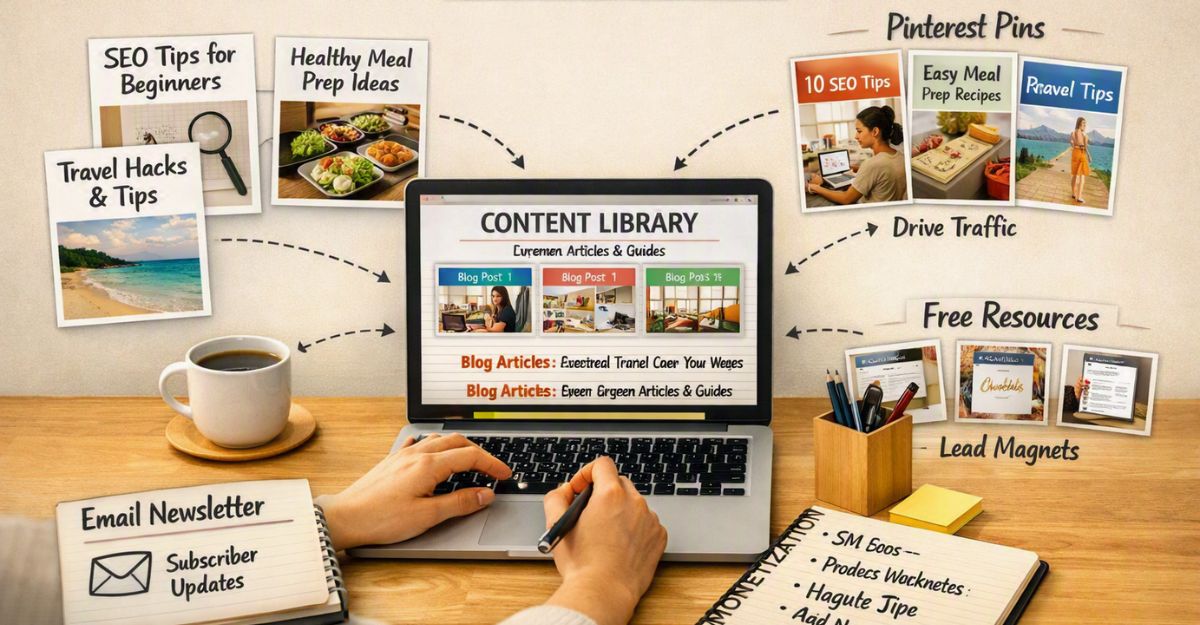
Evergreen Content Can Build Your Content Library
Think about what happens when you consistently create useful evergreen articles. At first, you might have five.
- Then ten.
- Then twenty.
Eventually, your website begins to develop a library of answers. A beginner can arrive at one article and discover several others. That is when your website starts becoming more than a blog. It becomes a resource.
And I think that is one of the strongest goals you can have as an affiliate marketer. You don’t simply want people to visit. You want them to think: This website actually helps me. That is how trust begins.
Don’t Chase Evergreen Content at the Expense of People
There is one warning I would add here. Don’t become so obsessed with creating evergreen content that your writing becomes robotic. People don’t read articles because they are technically evergreen. They read them because the information is useful.
They understand the writer. They feel that the article is speaking directly to their situation. That is why I still want my own articles to include personal experience. If I have made a mistake, I want to explain it. If something didn’t work the way I expected, I want to say so.
If I discovered something that made the process easier, I want to share it. Evergreen content doesn’t have to be cold and timeless. It can still have personality.
If you’re still building your first collection of affiliate marketing content, don’t worry about trying to make every article go viral. Focus first on creating genuinely useful content that answers the questions your audience is already asking.
If you are starting from scratch, my Beginner Guide is a useful place to continue because it brings the basic pieces together in one place.

What About Articles With Dates?
Dates can be useful when they genuinely matter. For example, a product review may need a year because the product changes. A platform review may need updating because the features change. But with evergreen educational content, I wouldn’t automatically add a year simply because everyone else is doing it.
If the article is designed to answer a long-term question, keeping the focus on the problem can sometimes make more sense. The important thing is accuracy. If the article becomes outdated, update it.
How Often Should Evergreen Content Be Updated?
There is no universal schedule. I would rather update an article because something has changed than update it simply because a certain number of months have passed. Keep an eye on your articles.
If a platform changes. If a tool disappears. If you discover better information. If your own experience changes your recommendation.
If the article starts attracting traffic but no longer answers the question as well as it could. Those are all good reasons to revisit it. And when you update an article, don’t just change the date. Actually improve it. Add value. Make the article better than it was before.

The Evergreen Content Flywheel
I see evergreen content as part of a larger cycle. You create a useful article. You optimise it. You create Pinterest pins. People discover the pins.
They visit your website. Some readers discover other articles. Some may join your email list. You learn from the data. Then you improve the original article and create more related content. That creates a cycle.
Create → Distribute → Discover → Trust → Improve → Repeat
The more useful content you build, the more opportunities you create for that cycle to continue. It doesn’t happen overnight. But over time, the pieces can begin supporting each other.
What I Would Create If I Were Starting Again
If I were starting a brand new affiliate marketing website today, I wouldn’t try to write about everything. I would build a foundation of evergreen content around the biggest problems beginners have. I’d answer the basic questions first.
What is affiliate marketing? How does it work? How do you choose a niche? How do you build a website? How do you create content? How do you get traffic? How do you build an email list? How do you avoid common beginner mistakes?
Then I would build more specific articles around those foundations. That creates a website that can grow naturally. And as I learned more, I would update the articles. That means the website could become better as I become better. I really like that idea.
Evergreen Content Doesn’t Mean Passive Income
I want to make this distinction because the word “evergreen” can sometimes be used in ways that make it sound too good to be true. Evergreen content doesn’t mean passive income. It doesn’t guarantee traffic. It doesn’t guarantee rankings.
It doesn’t guarantee affiliate commissions. You still need to promote your content. You still need to understand your audience. You still need to update information. You still need to build trust. And you still need patience. What evergreen content does is give you the potential to create longer-lasting assets. That is valuable enough.
Final Thoughts
When I look at the content I am building now, I don’t want every article to be something that is useful for only a few weeks. I want to build a library. A library of helpful answers. A library that a beginner can discover today and still find useful later.
That’s why I like evergreen content. It changes the way you think about your workload. Instead of constantly asking what you can publish next, you start asking what you can build that will continue to serve your audience. That doesn’t mean every article has to be perfect.
It doesn’t mean you should spend weeks trying to create one article. It simply means you should think beyond the publication date. Create something useful. Make it easy to discover. Connect it to the rest of your website.
Keep it accurate. Update it when necessary. Then move on and build the next asset. Over time, those individual pieces can become something much bigger. Your content library becomes part of your business. And that, for me, is one of the most exciting parts of building an affiliate marketing website.
Ready to Build Your Affiliate Marketing Foundation?
If you’re still building the foundation of your affiliate marketing business, my Beginner Guide to Affiliate Marketing is a good place to continue. It brings together the basic concepts and gives you a clearer picture of how the different pieces fit together.
And if you’re interested in learning more about the platform I use as part of my affiliate marketing journey, you can also read my Wealthy Affiliate Review. You don’t need to create hundreds of articles. Start by creating useful ones. Then build from there.

One helpful article can become the beginning of an entire content library.
Pinterest vs Google SEO for Beginners
Learn why Pinterest and Google can serve different roles in your traffic strategy and how they can work together.
Why Your Blog Isn’t Getting Traffic Yet
If you have been publishing content but aren’t seeing the traffic you expected, this article explores some of the reasons why and what you can do about them.
How to Get Traffic from Pinterest for Affiliate Marketing: A Beginner’s Guide
Learn how Pinterest can become part of your content distribution strategy and how to use pins to introduce people to your articles.
How to Build an Affiliate Marketing Habit
Evergreen content is valuable, but building it requires consistency. This article explores how to develop a realistic affiliate marketing routine.
How to Stay Organised as an Affiliate Marketer
As your content library grows, having a simple system for managing your articles and pins becomes increasingly important.
Frequently Asked Questions
What is evergreen content?
Evergreen content is content designed to remain useful and relevant for a long period of time. It usually focuses on questions, problems or subjects that people will continue to need help with.
Why is evergreen content important for affiliate marketing?
Evergreen content can help you build a long-term library of useful information. It can continue attracting readers, support internal links and provide entry points into your wider affiliate marketing ecosystem.
Is evergreen content always relevant?
Not necessarily. The underlying topic can remain evergreen while some of the information changes. You may need to update examples, tools, statistics, links or recommendations to keep the article accurate.
Can evergreen content rank on Google?
Evergreen content can have long-term search potential, but there are no guarantees. Search rankings depend on many factors, including relevance, competition, content quality and the overall strength of the website.
Is Pinterest good for evergreen content?
Pinterest can be a useful distribution channel for evergreen content because people use the platform to discover information and ideas. Creating multiple useful pins around an evergreen article can give that article additional discovery opportunities.
How do I find evergreen topics?
Start with recurring problems. Ask what questions your audience will continue to have, what mistakes beginners regularly make and what information someone new to your niche will always need.
Does evergreen content need to be updated?
It can. Even evergreen topics can contain information that becomes outdated. Review your content when important changes occur and improve it whenever you have genuinely useful new information.
Is evergreen content better than trending content?
Neither is automatically better. Evergreen content is designed for longevity, while trending content can help you take advantage of current interest. A balanced content strategy can use both.