


Have your Pinterest impressions suddenly dropped, leaving you wondering what you are doing wrong? Perhaps you have been creating pins consistently, following your publishing schedule and trying to improve your designs, yet your numbers seem to be moving in the wrong direction. It can be frustrating, particularly when you are putting considerable time and effort into building your affiliate marketing business.
I recently experienced something similar with my own Pinterest account. My first instinct was to find out what had changed, but I also realised that making too many adjustments at once could make it impossible to understand what was actually happening. Before you abandon your Pinterest strategy or start changing everything, here are seven things I believe are worth checking.
My Personal Experience With Dropping Pinterest Impressions
During one of my recent Pinterest reviews, I noticed that my impressions had fallen from approximately 9,000 to around 2,000. Naturally, I wanted to understand why. I began questioning my board selection, my pin designs, my publishing frequency and whether seasonal changes might have influenced the results.
However, something from my earlier Pinterest experience encouraged me not to panic. There was a period when I had close to 10,000 impressions without receiving the affiliate results I wanted. Yet when my impressions were considerably lower, at around 3,000, I received my first paid referral through Pinterest.
That experience taught me that visibility and business results do not always move together. More recently, I have been reviewing my board strategy and developing a structured Pinterest experiment that I call my Get Seen Experiment. The objective is to understand which messages, designs and content destinations attract genuinely interested visitors.
I have not established exactly why my impressions declined, and I would rather be transparent about that than offer an explanation I cannot support. If you are new to building an online business, my Affiliate Marketing Beginner Guide will help you establish the foundations before you become overwhelmed by traffic statistics.
1. Check Whether You Are Looking at the Bigger Picture
One of the first things I do when reviewing Pinterest performance is compare different reporting periods. Looking at the last seven days can be useful, but it does not always provide enough information to tell whether your overall strategy is working. A disappointing week can look very different when you view it alongside the previous 30 or 90 days.
Open Pinterest Analytics and compare equivalent reporting periods. Look at impressions, outbound clicks, saves and engagement rather than concentrating on a single number. If your impressions have declined but your outbound clicks have increased, your content may still be attracting a more relevant audience.
During one of my own reviews, impressions were down by about 7.5% while outbound clicks were up by 120% over the same reporting period. The actual number of clicks was still small, but it reminded me that fewer impressions do not necessarily mean worse results. My article on Pinterest Analytics for Beginners explains these measurements and why they matter.
Next step: If you are not sure which numbers deserve your attention first, the Affiliate Marketing Beginner Guide shows where Pinterest fits into the bigger picture.
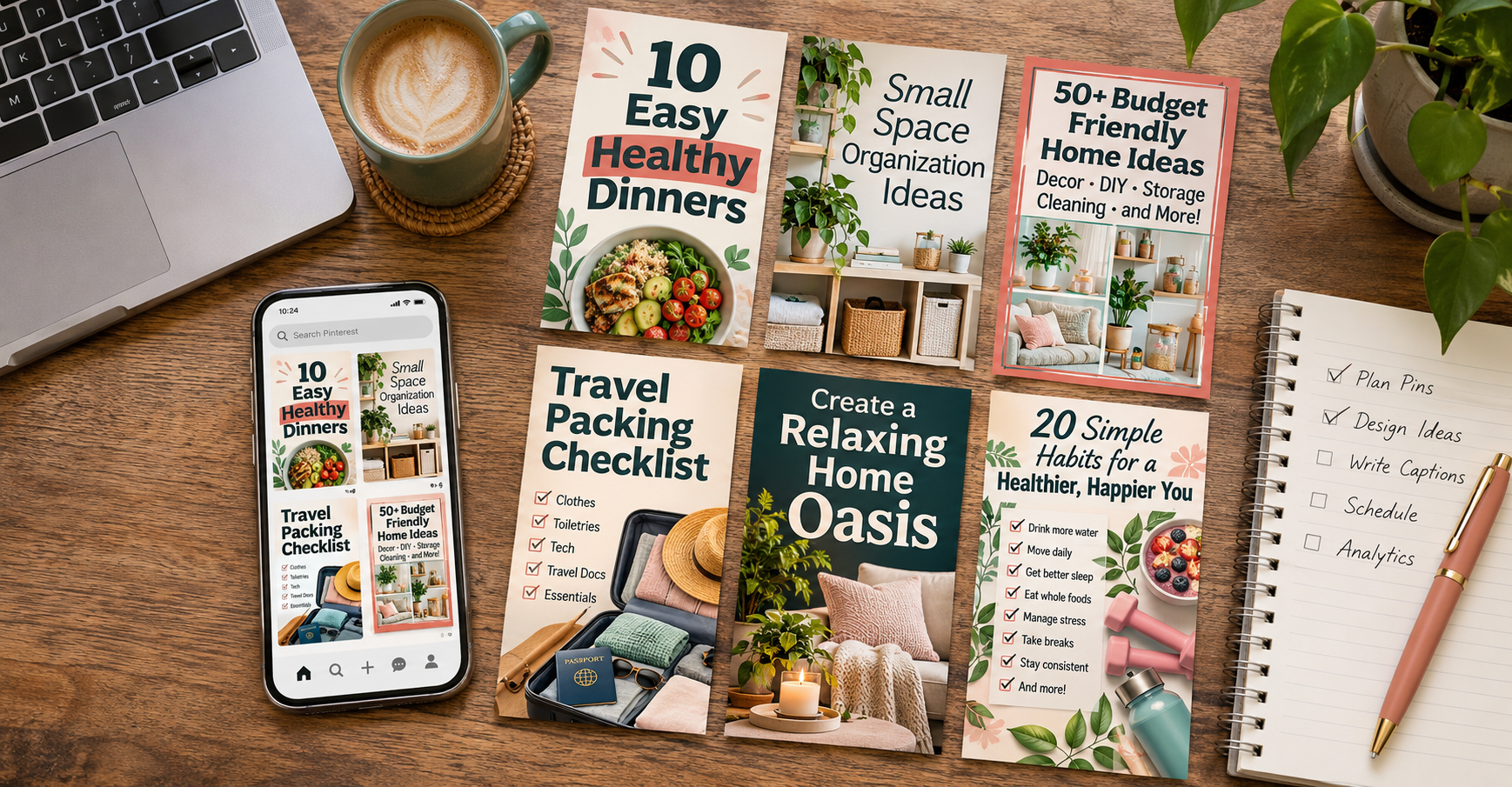
2. Review Your Pin Designs and Text Size
When creating Pinterest pins, it is easy to become so focused on making them look attractive that you forget how they will appear on a mobile phone. A headline that looks perfectly readable on a computer screen can be difficult to read while someone is scrolling on their phone.
I have experimented with different text sizes, fonts, colours, layouts and photographs. On some of my earlier pins, I used very large overlay text at around 140pt. My newer pins use a smaller size, around 60 to 80pt.
I have not confirmed that text size caused my impressions to drop, and Pinterest has not told me that it did. That is why I am comparing the performance of my older pins with my newer ones before making any changes to my existing designs.
My current approach is to use vertical pins measuring 1000 by 1500 pixels, with a prominent headline, strong colour contrast and enough space around the text. I also avoid crowding the design with unnecessary information.
Open a few of your recent pins on your phone and ask yourself whether you can understand the main message immediately. If you have to zoom in or spend too long reading, people may simply keep scrolling. Better readability does not guarantee more impressions, but it makes your pins easier to understand and engage with.
3. Check Whether You Are Using Relevant Pinterest Boards
Board selection is another area I have been investigating, and it produced a surprise. I have several boards covering affiliate marketing, blogging, online business and the tools I use to build my website. For a while, my “WA Review and Guide” board was producing almost no impressions, while my “Affiliate Marketing for beginners” board kept getting some.
I then created a new board called “Affiliate Marketing Tools and Reviews”. Afterwards, my “WA Review and Guide” board began picking up more clicks and saves, which I did not expect. I cannot prove that the new board caused this. It could be the new pins, the smaller text size, timing, or a mixture of things. But it taught me that a board that looks quiet is not necessarily broken.
If you identify a relevant topic that your existing boards do not adequately cover, consider testing one closely related board rather than abandoning your existing boards or creating several new ones at once. Ask yourself whether each pin, its board and the person searching for that topic belong together.
Next step: If your content is not yet focused on one clear audience, start with the Affiliate Marketing Beginner Guide so your boards have a clear purpose.

4. Examine Your Pinterest Publishing Frequency
Have you recently changed how often you publish pins? Perhaps you were publishing consistently for several weeks before taking a break. Alternatively, you may have increased your frequency considerably because you wanted faster results. Both situations are worth examining when you review your performance.
My preference is to keep a manageable routine that lets me maintain quality without becoming overwhelmed. I also keep track of the date whenever I change something, which makes it easier to compare performance before and after.
If you change your publishing frequency, board selection, pin designs and content topics all at the same time, it becomes very difficult to tell which change influenced your results.
There is no universal number of daily pins that guarantees success. Find a routine you can maintain, create genuinely useful content and give yourself enough time to evaluate the results.
5. Check Your Pin Destination Links
When was the last time you clicked through your own Pinterest pins?
We spend considerable time creating attractive designs and writing descriptions, but we sometimes overlook what happens after someone clicks. Check that your pins lead to the correct articles, that your website loads properly on mobile devices and that the destination page delivers what your pin promises.
For example, if your pin promises to explain how a beginner can write an affiliate product review, it should lead directly to an article that answers that question. Sending visitors to an unrelated page creates a disappointing experience and makes them less likely to explore your website.
I also add tracking parameters to my Pinterest links, so I can see which pins are bringing visitors to my website. Checking your links may not explain a decline in impressions, but it makes sure the traffic you do receive has a fair chance of producing meaningful results.
Building an online business involves connecting several pieces together, from creating helpful content to attracting visitors and earning their trust. In my Wealthy Affiliate review, I explain the training and tools I use to develop these different areas of my business.
6. Consider Seasonal Changes and Audience Interest
Not every decline in Pinterest impressions is caused by something you have done.
People’s interests change throughout the year. Holidays, seasonal activities and changing priorities can all influence what people search for and engage with. Someone interested in starting an online business might spend less time researching affiliate marketing during a busy holiday period, for example.
However, I would not automatically blame seasonality whenever my numbers decline. Instead, I would use Pinterest Trends to see whether interest in relevant search terms has changed, where data is available for the audience I am targeting. Comparing your current performance with earlier periods can also give useful context.
Seasonality is a possible explanation, not a conclusion to reach without investigating further.
7. Check Your Account Status Before Making Major Changes
If your impressions have dropped dramatically, particularly across most of your pins, check whether Pinterest has sent you any account notifications.
Review your emails, account settings and any available notifications for information about content restrictions, policy violations or problems with your website links. It is also worth reading Pinterest’s community guidelines to make sure your publishing practices comply with them.
Avoid repeatedly publishing identical pins or using misleading headlines simply to attract attention. If you do find an actual account issue, address it through the appropriate Pinterest support channels.
However, a decline in impressions alone does not prove that your account has been restricted. Avoid assuming that Pinterest has penalised your account without evidence.

My Simple Pinterest Troubleshooting Checklist
Whenever I notice a decline in Pinterest performance, I want to look into it systematically rather than react emotionally. Here is a simple checklist you can use when reviewing your own account.
- Compare your seven day, 30 day and 90 day performance.
- Check your pin designs on a mobile phone.
- Review the relevance of your Pinterest boards.
- Examine any changes to your publishing frequency.
- Test your pin destination links.
- Investigate possible changes in audience interest.
- Check for account notifications or restrictions.
Once you have completed these checks, write down what you discovered and choose one meaningful adjustment worth testing. Record the date you made it and review the results over a reasonable period.
You may find that your strategy needs improvement, or you may find that your concern was based on a temporary fluctuation. Either way, you will be making a more informed decision.
Next step: Keeping a simple record of what you change and when is one of the habits I teach in the Affiliate Marketing Beginner Guide.
Why I Am Not Giving Up on Pinterest
Despite the fluctuations in my impressions, I have no intention of abandoning the platform simply because my numbers have declined. I have already seen first-hand that Pinterest can contribute towards affiliate referrals. My challenge now is to understand how to make that process more consistent.
Through my Get Seen Experiment, I intend to test different messages, visual approaches and content destinations while monitoring outbound clicks and website engagement. I cannot tell you in advance which approach will produce the best results. That is exactly why I am running the experiment.
My objective is to test these strategies on my own website, measure the results, improve what needs improving and eventually share what I learn with other beginner affiliate marketers.
If you are concerned that Pinterest is taking too long to produce results, my article on Why Pinterest Traffic Compounds Over Time explains why your earlier work may still have opportunities to attract visitors.
Final Thoughts
When your Pinterest impressions drop, it is understandable to question whether your strategy is working. However, changing everything immediately can create more problems than it solves.
Start by examining your statistics, reviewing your content and investigating what may have changed. Give yourself time to understand the situation before making significant adjustments.
Remember that impressions are only one part of building a successful affiliate marketing business. Attracting the right visitors, helping them solve problems and earning their trust are equally important.
I am continuing to learn through my own Pinterest experiences, and I intend to share both the successes and the challenges along the way. Building an online business is not about getting everything right the first time. It is about learning, improving and staying consistent enough to discover what works.
Not sure what step to take next?
If you would like a clearer direction for your online business, my Affiliate Marketing Beginner Guide walks you through the essential foundations, one manageable step at a time.
- Pinterest Analytics for Beginners: The Numbers That Matter
- Why Pinterest Traffic Compounds Over Time
- Why Pinterest Is Perfect for Beginner Affiliate Marketers
- Why Your Blog Isn’t Getting Traffic Yet
Frequently Asked Questions
Why have my Pinterest impressions suddenly dropped?
Pinterest impressions can decline for several reasons, including changes in audience interest, publishing activity, content relevance and distribution. Review your analytics and account notifications before assuming a particular cause.
Does a drop in Pinterest impressions mean my account has been penalised?
No. A decline in impressions does not automatically indicate an account penalty. Check your account notifications and emails for evidence of restrictions before reaching that conclusion.
Should I stop publishing pins when my impressions drop?
Not necessarily. If your account is in good standing, keeping a consistent publishing routine while you investigate the decline may be more useful than stopping completely.
Can changing Pinterest boards improve my impressions?
Publishing pins to relevant boards may help organise your content and communicate its subject. However, changing boards does not guarantee more impressions. Test board selection carefully and monitor the results.
How long should I wait before changing my Pinterest strategy?
A review after seven to 14 days can give an early indication of performance, while a 30 day comparison offers more useful context. Smaller accounts may need longer to collect enough information.
Can I still make affiliate sales when my Pinterest impressions are low?
Yes. Lower impressions do not prevent affiliate sales. The relevance of your audience, the quality of your content and the effectiveness of your affiliate marketing strategy all influence your results.